
- All
- Product Name
- Product Keyword
- Product Model
- Product Summary
- Product Description
- Multi Field Search


Views: 0 Author: Site Editor Publish Time: 2026-06-05 Origin: Site


Off-center turning introduces unpredictable lateral forces, severe vibration, and extreme demands on your lathe's workholding. When spinning asymmetric blanks, standard rotation rules simply do not apply. At the bottom of the funnel, the decision between a lathe chuck and a faceplate isn't just about convenience. It is a critical calculation of mechanical safety, material integrity, and workflow efficiency. Choosing the wrong mounting method for an unbalanced blank can result in ruined workpieces. Worse, it can trigger catastrophic tool failure.
This guide breaks down the structural limits, implementation risks, and evaluation criteria for both methods. You will learn exactly how mass distribution impacts holding requirements. We will also explore industry-specific standards across wood and metal machining. Ultimately, these insights will help you standardize your off-center workholding securely and effectively.
Safety dictates the baseline: Faceplates offer unparalleled mechanical grip for severely unbalanced, heavy, or wet blanks, mitigating the risk of structural failure.
Efficiency has limits: A 4-jaw lathe chuck accelerates workflow and preserves material but relies heavily on the shear strength of a tenon—making it vulnerable during aggressive off-center turning.
Material context matters: In metalworking, independent 4-jaw chucks handle 99% of off-center work. In woodturning, grain orientation (end-grain vs. side-grain) frequently forces the use of a faceplate.
Hybrid workflows minimize risk: Best practices involve starting off-center blanks between centers to establish balance before committing to a chuck or faceplate.
Off-center turning creates unique physics. It forces the spindle bearing and the workholding joint to absorb asymmetrical loads. Centered turning spreads forces evenly across a continuous axis. Off-center turning constantly pulls the workpiece away from the center. Standard centered turning rules do not apply here. A setup might feel perfectly secure while stationary. However, once the machine powers on, lateral vibration multiplies instantly. You need a holding strategy engineered specifically for imbalance.
Evaluating holding requirements means understanding mass distribution. An off-center mount must resist rotational torque and aggressive lateral pull. Centrifugal force scales dramatically as RPM increases. It pulls the heaviest section of the blank outward. Your chosen mount must fight this exact force. If the grip strength falls below the lateral pull, the workpiece will dislodge. You must calculate the weight, density, and overhang of your material before mounting it.
Every mounting system possesses a weak link. Identifying this bottleneck prevents dangerous accidents.
Lathe Chucks: The point of failure is usually the material itself. When lateral loads peak, the wood tenon might snap. Alternatively, an internal recess might split open. You rely entirely on the shear strength of a very small material section.
Faceplates: The point of failure shifts to the screw bite. Pull-out strength determines safety. This relies heavily on fastener quality and grain direction. If screws pull out, the faceplate loses its mechanical advantage immediately.
A faceplate provides the widest possible footprint. It delivers the most secure mechanical grip available. By utilizing multiple anchor points, it distributes asymmetrical loads evenly. This makes it the non-negotiable standard for highly irregular, massive, or wet blanks. The wide diameter acts as a structural anchor. It prevents the heavy side of a blank from leveraging itself off the spindle.
Using a faceplate safely requires strict attention to detail.
Screw Selection: Never use brittle drywall screws. They lack shear strength and will snap under off-center vibration. Always require thick-shanked sheet metal screws. Specialized wood screws, like Spax, also provide exceptional shear resistance.
The Tannin Acid Risk: Wet wood presents chemical challenges. Standard steel screws react poorly with wet wood tannins. This reaction leaves deep black stains in the blank. You must account for this if the mounting area remains in the final piece.
End-Grain Vulnerability: End-grain offers poor bite. Screws driven parallel to the grain have incredibly low pull-out resistance. The threads simply slice between the fibers instead of gripping them.
To safely mount end-grain on a faceplate, you need intervention methods. The "plug method" works exceptionally well for this. Follow these steps to execute it:
Measure your faceplate hole spacing and mark the blank.
Drill cross-grain holes at least 30mm from the edge of your workpiece.
Glue hardwood dowels tightly into these cross-grain holes.
Drive your mounting screws directly into these side-grain dowels.
Alternatively, you can utilize a glue or waste block. Glue a sacrificial piece of side-grain wood to your blank. You then screw the faceplate entirely into the waste block. This prevents damaging the final piece while ensuring secure grip.
Faceplates demand high setup time. They lock you into a permanent orientation. Once mounted, adjusting the off-center axis requires completely unmounting the piece. You must re-measure, re-drill, and remount. This slows down production significantly during complex multi-axis turning.
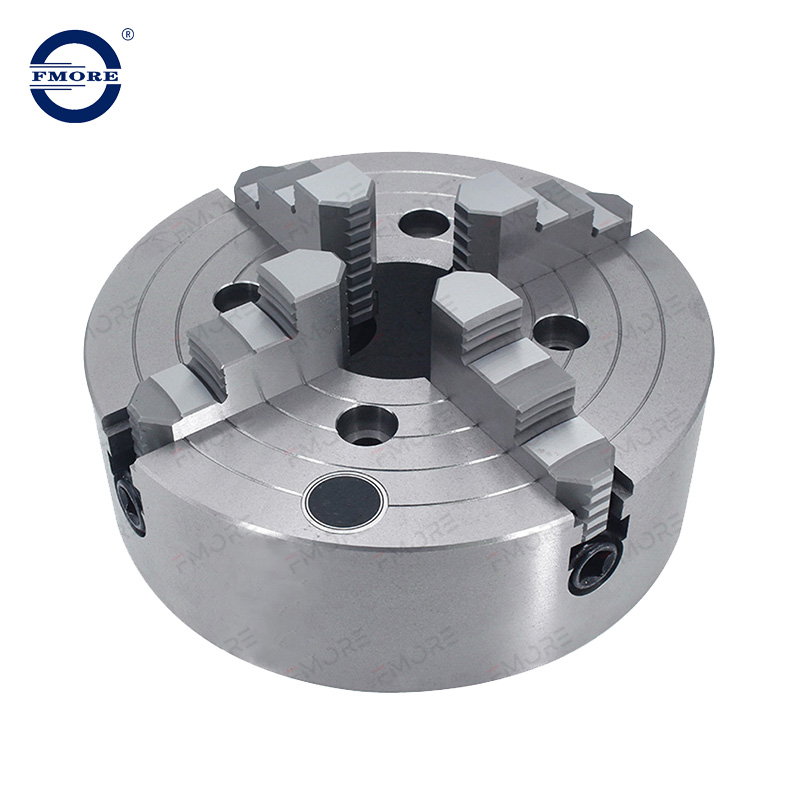
A Lathe Chuck operates via direct physical compression or expansion. It compresses onto a tenon or expands into a recess. This mechanism makes it extremely fast to mount, unmount, and remount. It provides a massive advantage for multi-axis turning. When the center point changes frequently, you cannot afford faceplate setup times. The rapid adjustment capabilities keep your workflow highly efficient.
Despite their speed, chucks have strict operational limits.
They are not recommended for blanks with severe overhang.
Extreme density variations (like half-punky burls) compromise grip stability.
Deep jaws are mandatory. You need a minimum 1-inch jaw depth for adequate off-center leverage. Standard dovetail jaws often fail to provide enough lateral support for heavy offset loads.
Understanding compression dynamics prevents ruined workpieces.
Expansion vs. Compression: Expanding jaws into a recess for off-center work is generally weaker. It forces outward pressure, which risks splitting the workpiece along the grain. Compressing a tenon forces fibers together. This remains the safer, more durable standard.
Jaw Marks: Heavy lateral forces push the workpiece against the metal jaws. This causes the jaws to crush wood fibers. It leaves permanent mechanical indentations on the tenon. You must plan to turn away these marks in the final finishing stage.
The "faceplate vs. chuck" debate changes entirely depending on the material. Metal behaves predictably. Wood contains grain patterns, moisture, and hidden defects. This distinction is critical for evaluating advice found in mixed machining forums. What works perfectly for steel can cause a violent failure in wet maple.
In metalworking, an independent 4-jaw Lathe Chuck reigns supreme. It allows each jaw to move separately. This means you can easily clamp square, rectangular, or heavily offset metal stock. In metal, these tools are roughly 20-to-1 more efficient than faceplates. Metal faceplates see very limited action. Machinists reserve them for extreme, bizarrely shaped castings. These unique parts might require tack-welding or complex T-slot bolting to hold secure.
Woodturning introduces different mechanical limits. Wood scroll chucks typically feature jaws that move together synchronously. They require perfectly round tenons to grip effectively. You cannot simply "offset the jaws" as you do in metalworking. Therefore, woodturners rely on faceplates for initial off-center balancing far more frequently. You must establish balance first, then form a tenon for later stages.
The workpiece is a large side-grain blank. Natural edge bowls with heavy, unpredictable mass fit this category.
The wood is punky, wet, or structurally fragile. Here, you should incorporate a glue block for safety.
Safety and holding strength heavily outweigh production speed.
You are turning smaller off-center items. Offset pendants, small hollow forms, and tool handles are prime examples.
You perform multi-axis turning. This requires rapidly shifting the blank between several pre-turned tenons.
Your stock is perfectly solid, dry, and free of hidden cracks.
Some situations require a middle ground. Chuck faceplate rings offer a highly effective hybrid approach. A bolted ring attaches to your workpiece using standard faceplate screws. You then grip the exterior of this ring using your lathe jaws. It offers secure screw mounting without removing the primary jaws from the spindle. However, this setup pushes the workpiece further away from the headstock bearings. This increased distance can introduce slight vibration during heavy roughing cuts.
Below is a quick reference table to help you match your tooling to your operational needs.
| Evaluation Criteria | Faceplate | 4-Jaw Lathe Chuck |
|---|---|---|
| Holding Strength | Maximum (relies on screw pull-out strength) | Moderate to High (relies on material shear strength) |
| Setup Speed | Slow (requires drilling and driving screws) | Very Fast (rapid jaw compression) |
| Ideal Material Condition | Wet, punky, deeply unbalanced, heavy mass | Solid, dry, moderately balanced, pre-turned tenons |
| Multi-Axis Suitability | Poor (requires complete remounting) | Excellent (fast repositioning between tenons) |
| Material Waste | High (screw holes or waste blocks required) | Low (only a small tenon or recess needed) |
For bottom-of-funnel decision-making, choosing between a chuck and a faceplate for off-center work comes down to mechanical leverage versus workflow speed. Do not compromise safety for efficiency. Start by assessing your blank's mass, moisture, and grain structure. If the blank is exceptionally heavy, deeply unbalanced, or structurally questionable, the faceplate is the only scientifically sound choice. It provides the wide footprint needed to counter aggressive centrifugal forces. For moderate off-center work requiring multi-axis repositioning, a robust 4-jaw tool equipped with deep jaws provides the necessary speed and adaptability. Always test balance between centers first, use high-quality fasteners, and respect the physical limits of your chosen material.
A: Screw chucks are highly efficient for shallow, face-grain work like small hollow forms. However, they lack the lateral support needed for long or heavy off-center workpieces. Their single central anchor point cannot safely counter severe rotational torque.
A: Use a compass to strike a circle based on your intended off-center axis. Alternatively, utilize a centering jig matched to a 3mm pilot hole. Always support the piece with a tailstock drive center first to test balance before committing to screws.
A: The most common standard for full-sized lathes is 1-1/4″ x 8tpi. Some European and robust professional models use M33x3.5. Ensure your tool inserts strictly align with your machine's specification before mounting.

