
- All
- Product Name
- Product Keyword
- Product Model
- Product Summary
- Product Description
- Multi Field Search


Views: 0 Author: Site Editor Publish Time: 2026-06-12 Origin: Site


Step onto any bustling machine shop floor, and you will immediately spot a familiar operational frustration. Machinists frequently struggle to safely hold rough foundry castings, non-standard rectangular stock, or offset parts using standard self-centering workholding tools. Scroll-based models inherently prioritize rapid operation over geometric adaptability. When you force irregular shapes into these rigid systems, you directly compromise operator safety and induce unwanted workpiece distortion. This fundamental mismatch strictly caps your overall machining precision right from the start.
For dedicated tool rooms, specialized repair shops, and elite precision machinists, the 4-jaw independent Lathe Chuck remains the only definitive solution. It empowers you to true-center odd shapes, completely eliminate runout, and safely execute eccentric turning. In this guide, you will learn exactly how to master its steeper setup curve to unlock uncapped accuracy for complex parts.
Uncapped Precision: Independent adjustments allow skilled operators to dial in Total Indicator Runout (TIR) to under 0.0005", outperforming the baseline 0.003" variance of standard scroll chucks.
Shape Versatility: Unlike 3-jaw or 4-jaw self-centering chucks, independent jaws safely secure asymmetric castings, perfect squares, hex stock, and eccentric parts without specialized soft jaws.
Direct Clamping Power: Independent screw mechanisms apply direct force, bypassing the mechanical fragility of scroll plates and preventing jaw wear from degrading clamping accuracy.
The Time Trade-off: Precision costs time. Operators must balance the 2–5 minute setup time of an independent chuck against the rapid (but less accurate) 15-second setup of self-centering alternatives.
Many shops default to 3-jaw chucks because they prioritize quick changeovers. However, this convenience introduces severe operational limits. All three jaws move synchronously via a shared scroll plate. This unified mechanism cannot adapt to localized dimensional variations. For example, rough casting draft angles or heavily scaled surfaces resist uniform clamping. The scroll plate forces the jaws into a compromised grip, causing the workpiece to rock or distort heavily under aggressive cutting loads.
We must also address the "4-jaw self-centering" myth. Many machinists mistakenly believe a self-centering 4-jaw model solves irregular holding problems. In reality, manufacturers build these tools primarily for perfectly square, pre-milled stock. If your stock sits even slightly out of square, a dangerous mechanical situation occurs. Two opposing jaws will bear the entire clamping load. The other two jaws simply float above the surface. This false security creates severe safety risks during high-speed spindle rotation.
Finally, consider secondary operation inaccuracies. Standard 3-jaw setups consistently fail when you flip a part for secondary machining. Removing and re-chucking a partially finished component almost guarantees a total loss of concentricity. Inherent scroll runout means the device never centers the part exactly the same way twice. You will waste valuable time trying to shim jaws or fighting a built-in wobble.
The mechanical difference behind uncoupled actuation is striking. Four jaws operate independently inside dedicated T-slots. Heavy-duty, square-threaded screws drive each jaw individually. This uncoupled actuation allows you to apply custom pressure and precise positioning for every single contact point. You fully control the alignment.
This design specifically excels at irregular and asymmetric workholding. You can securely grip odd shapes like rough foundry castings, welded assemblies, or asymmetrical rectangular blocks. By adjusting each jaw manually, you establish a custom center point. The exterior geometry simply does not dictate your turning axis.
Machinists also leverage this mechanism for intentional eccentric turning. You frequently need to shift the rotational axis to machine offset features. Turning a throw on a custom crankshaft requires exact off-center placement. You achieve this by calculating thread pitch turns and backing off one jaw while advancing the opposite jaw by the exact same amount.
Here are the core steps for executing an eccentric offset setup:
Center the workpiece perfectly using a dial test indicator to establish a strict zero-reference.
Calculate the required offset distance for your specific eccentric feature.
Determine how many jaw screw rotations equal your offset based on the screw thread pitch.
Loosen one jaw by the calculated rotations while tightening the exact opposite jaw to match.
Verify the new eccentric center using your indicator before starting the spindle.
Beyond adaptable geometry, independent systems deliver superior grip and safety. Direct screw-to-jaw pressure provides exponentially higher clamping force compared to indirect scroll pressure. Scroll plates inherently suffer from mechanical flex and internal friction loss. Independent screws lock the workpiece down solidly. This direct power transfer is absolutely critical when spinning heavy, unbalanced irregular parts at high RPMs. You can aggressively rough out uneven castings without fearing the part will dislodge.
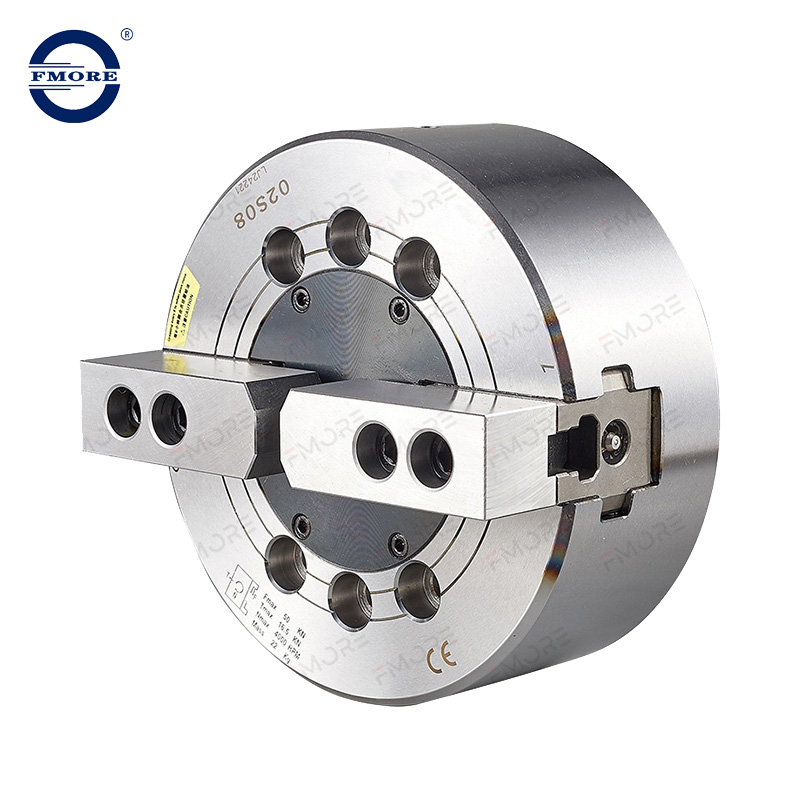
True precision requires absolute mechanical authority. A high-quality 4-jaw independent Lathe Chuck automatically compensates for its own internal wear. Since you adjust the jaws relative to a dial test indicator (DTI), mechanical flaws stop mattering. Screw backlash or heavily worn jaw teeth do not negatively affect your final concentricity. You simply dial past the wear.
You evaluate this accuracy using the TIR formula: TIR = 2e. Total Indicator Runout is exactly twice the actual radial offset (e). When your indicator shows a high spot, the error is doubled because it reads both extremes of the rotational axis. To correct a runout error, you move the opposing jaws a distance equal to exactly half the TIR.
Let us look at standard precision benchmarks across different workholding styles.
| Workholding Device | Expected Runout (TIR) | Wear Compensation | Best Use Case |
|---|---|---|---|
| 3-Jaw Scroll Chuck | 0.002" – 0.006" | None (Requires regrinding) | Rapid, first-operation roughing |
| 4-Jaw Self-Centering | 0.002" – 0.005" | None | Perfectly square bar stock |
| 4-Jaw Independent | <0.0005" | Complete (Manual dial-in) | Irregular shapes, extreme precision |
Sometimes, you will encounter a diagnostic reality check. What happens if your TIR simply will not drop below 0.002" on an independent setup? Operators often wrongly blame the tool. In reality, the chuck rarely causes this issue. The culprit is typically a rough workpiece surface deflecting the indicator needle. It might also be hidden debris trapped tightly against the spindle backplate. Alternatively, your DTI probe might be bent or binding. Always check these external environmental factors before doubting your clamping setup.
We must evaluate realistic implementation risks. Uncapped precision heavily costs time. A seasoned machinist typically takes 2 to 5 minutes to fully dial in a 4-jaw independent setup. Compare this to a mere 10 to 15 seconds for a standard 3-jaw scroll model or a quick-action 5C collet. You must weigh this operational trade-off carefully.
Scaling your shop dictates your equipment choices. High-volume production environments demand speed. If you machine hundreds of identical cylindrical parts daily, you need power collets or hydraulic self-centering setups. However, prototyping labs, custom repair bays, and casting finishing stations operate differently. These variable environments dictate the absolute necessity of the 4-jaw independent mechanism.
You can mitigate this learning curve through proven shop techniques. Faster adoption requires standardizing your setup approach.
Use Concentric Rings: Look closely at the face of the chuck. Use the machined concentric rings for your initial visual alignment. This rough setup routinely gets you within 0.030" before you even mount the indicator.
Adjust in Pairs: Always adjust opposing jaws in pairs (e.g., Jaw 1 and 3, then Jaw 2 and 4). Never chase the high spot randomly around the dial.
Maintain Slight Tension: Keep a light, uniform friction on all four jaws while dialing. If you loosen a jaw completely, the heavy part will slip downward and ruin your indicated progress.
Implementing these best practices drastically reduces setup friction. Over time, muscle memory takes over. Your 5-minute struggle eventually drops to under two minutes of controlled, rhythmic adjustment.
If your budget allows, you might explore alternative hybrid solutions. Enter the combination chuck. Specialized brands manufacture highly sought-after combi-chucks. These unique units feature a traditional scroll plate to provide rapid self-centering capability. However, each individual jaw also features a secondary independent micro-adjustment screw.
This hybrid design delivers the best of both worlds. You achieve fast, repeatable chucking for standard round stock. The baseline repeatability often hovers tightly around 0.001". When you face an irregular casting or demand absolute zero runout, you engage the independent screws. You can micro-adjust every single jaw to compensate for the scroll plate's inherent structural flaws.
Before purchasing, you must frame these capabilities against strict business-case realities.
First, consider the upfront purchase price. Combination models are significantly more expensive than standard independent units. The complex internal machining required to combine both mechanisms drives the manufacturing price up drastically.
Second, evaluate the physical weight and working envelope. These tools are incredibly heavy and bulky. A standard 8-inch combi-chuck paired with a heavy-duty backplate can easily weigh over 80 pounds. This massive bulk heavily increases the starting load on your spindle bearings. Furthermore, the extended depth of a combination body eats directly into your useable bed length. This length reduction causes serious tool clearance issues on smaller toolroom lathes.
While 3-jaw models offer undeniable convenience, the 4-jaw independent Lathe Chuck remains absolutely mandatory for uncompromising precision. It safely grips irregular castings, handles asymmetric geometry, and unlocks complex eccentric turning operations.
We highly advise buyers to carefully consider their primary daily workflow. If machining odd shapes or requiring flawless secondary-operation perfection is a weekly occurrence, the choice is overwhelmingly clear. The upfront investment in a high-quality independent unit heavily outweighs the initial setup time penalty. If your budget allows, a combination chuck serves as an exceptional, premium bridge between speed and accuracy.
As an actionable next step, actively evaluate your current lathe's specific spindle mount. Identify whether you utilize a D1-4 camlock, a threaded spindle, or an A-style mount. Document your backplate mounting requirements today to begin effectively shortlisting the optimal chuck size for your shop.
A: Soft jaws can indeed be custom-milled to cradle a specific irregular shape. However, they are generally single-use items tailored to one specific part profile. They take considerable time to properly machine and bore. Furthermore, soft jaws do not solve the inherent concentricity limitations of the underlying scroll plate mechanism.
A: A high-quality 5C collet is extremely accurate (often <0.0005" TIR) and much faster to operate. However, collets are strictly limited to small, perfectly uniform, and standard-shaped bar stock. The 4-jaw independent chuck matches the collet's extreme precision but easily scales to hold large, oddly shaped, and unbalanced geometries.
A: Prevention requires diligent maintenance. You must keep the square-threaded jaw screws meticulously clean and well-oiled. Regularly clear away metal chips and abrasive dust from the internal T-slots. Additionally, monitor your setup for excessive wrench backlash. Severe backlash often indicates worn threads, meaning screw replacement is necessary for smooth operation.

