
- All
- Product Name
- Product Keyword
- Product Model
- Product Summary
- Product Description
- Multi Field Search


Views: 0 Author: Site Editor Publish Time: 2026-06-03 Origin: Site


The maximum RPM stamped on a machine nameplate rarely reflects the safe operating speed for its workholding. Many machinists blindly trust these machine limits. They ignore critical chuck and workpiece variables. This oversight causes catastrophic shop floor failures. You must select the right Lathe Chuck by carefully balancing fast cycle times against strict safety margins. You have to account for material limitations and dynamic balance. Misjudging this balance risks destroying expensive equipment. It also severely endangers operators. This article clarifies the strict physical limits of standard jawed fixtures. We will outline the vital differences between budget and performance construction materials. You will also learn a practical decision framework. This guide helps you evaluate high-speed workholding upgrades safely and effectively.
A standard 8-inch semi-steel lathe chuck typically maxes out between 1,500 and 2,000 RPM, while forged steel variants can reach higher thresholds safely.
Machine spindle capacity (often 3,000+ RPM) does not dictate chuck capacity; the chuck dictates the operational limit.
Centrifugal force degrades clamping pressure at high speeds—as RPM increases, the jaws are forced outward, weakening their grip on the workpiece.
Material construction, dynamic balancing, and workpiece eccentricity are the strict limiting factors for operational speed.
High-speed machining (10,000+ RPM) requires specialized workholding, such as collet systems or precision-balanced forged steel chucks.
High-speed rotation introduces brutal physics into the machining environment. Centrifugal force acts relentlessly on every rotating component. As RPM rises, this outward force pulls the heavy chuck jaws away from the center. It fights directly against your clamping mechanism. This physical reality creates a strict ceiling for safe operation.
You lose massive amounts of gripping pressure as speed increases. Static clamping force only exists when the spindle is stationary. A Lathe Chuck spinning at its maximum rated speed might retain just a small fraction of its original grip. The jaws physically want to fly outward. They pull away from the workpiece. This directly subtracts from the effective holding power.
Shop floors regularly encounter the "heavy part" reality. You rarely machine perfectly symmetrical, lightweight cylinders. Heavy, off-center, or wedge-shaped parts amplify centrifugal risks exponentially. Consider a common shop scenario. An operator runs a heavy asymmetrical aluminum block at 2,000 RPM. They ignore the grip loss caused by centrifugal force. The jaws lose their bite. The block ejects like a missile. It destroys tooling, tears through machine enclosures, and creates a deadly hazard.
Running large fixtures at maximum speed also destroys machine components. It generates immense heat inside the headstock. This stresses large-bore spindle bearings. It degrades lubrication rapidly. You accelerate machine wear significantly when you constantly push limits. To mitigate these risks, you must understand the primary physical forces at play:
Jaw Mass Migration: Heavier jaws create more outward centrifugal pull, requiring lower speeds.
Dynamic Imbalance: Minor weight differences multiply at high speeds, creating violent spindle vibrations.
Friction Loss: Coolant and material debris reduce the friction coefficient between jaws and the part.
Thermal Expansion: Sustained high RPM heats the spindle, potentially altering workholding tolerances.
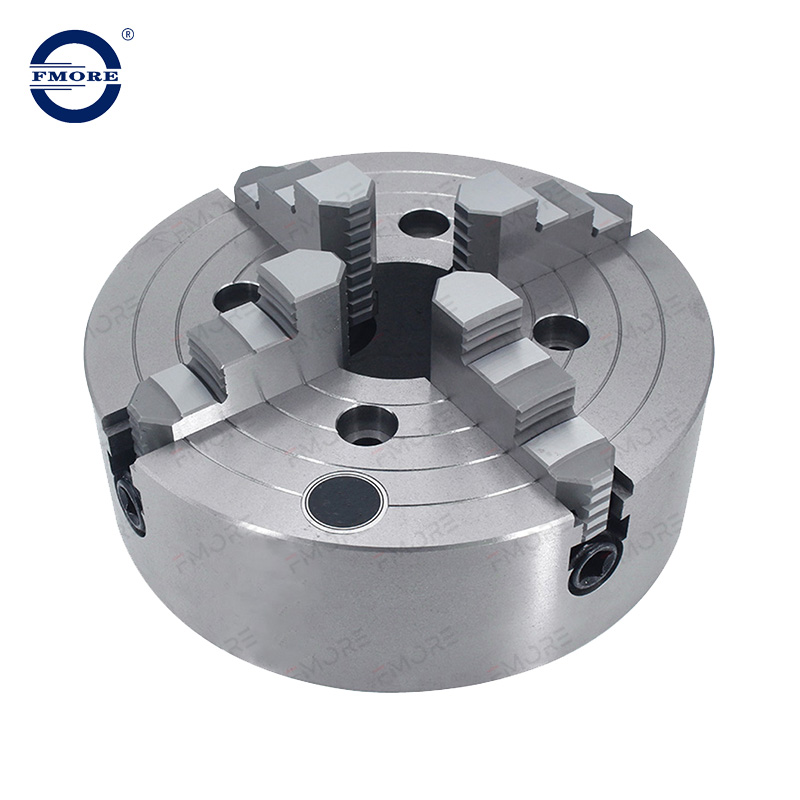
Many operators fall victim to a dangerous misconception. A lathe might feature a spindle rated for 4,000 RPM. This does not mean the standard-issue 10-inch fixture can safely run at 4,000 RPM. The machine manufacturer rates the naked spindle. The workholding manufacturer rates the gripping device. The lowest rating always dictates your absolute maximum speed.
You must differentiate between Revolutions Per Minute (RPM) and Surface Footage per Minute (SFM). RPM simply measures rotational frequency. SFM measures the actual linear speed at the outer edge. As fixture diameter increases, the outer edge travels much farther per revolution. This means linear speed scales exponentially, even if RPM stays constant. High SFM creates massive centrifugal forces. A small 4-inch fixture at 3,000 RPM behaves entirely differently than a 12-inch fixture at 3,000 RPM.
Hydraulic models introduce unique operational risks. Manual variants rely on a scroll gear to lock jaws in place. Hydraulic versions supply constant cylinder pressure. This pressure fights centrifugal pull dynamically. However, a critical failure point exists. If the RPM-induced centrifugal force exceeds the hydraulic cylinder's maximum pressure, the jaws open. Catastrophic grip failure occurs instantly. The operator gets no warning vibration.
Below is a simplified reference chart demonstrating how diameter affects peripheral speed. It highlights why larger fixtures require drastically reduced RPM limits.
| Chuck Diameter | Spindle Speed (RPM) | Approximate Surface Speed (SFM) | Centrifugal Risk Level |
|---|---|---|---|
| 6 inches | 2,000 | 3,141 SFM | Moderate |
| 8 inches | 2,000 | 4,188 SFM | High |
| 10 inches | 2,000 | 5,235 SFM | Severe |
| 12 inches | 2,000 | 6,283 SFM | Extreme (Likely Failure) |
Choosing between budget models and high-performance fixtures requires careful evaluation. You must understand how material strength limits your production speed. Faster cycle times improve profitability. However, pushing weak materials past their limits guarantees disaster. Evaluating construction materials helps you solve this business problem safely.
Cast iron or semi-steel constructs represent the industry standard for budget operations. Manufacturers blend cast iron to create a semi-steel body. These are economical and highly durable for standard operations. They absorb vibration exceptionally well. However, they possess lower tensile strength. A standard 8-inch semi-steel Lathe Chuck generally maxes out between 1,500 and 2,000 RPM. They handle low-speed, large-diameter turning perfectly. They fail structurally under extreme rotational stress.
Forged steel fixtures serve as the definitive performance upgrade. Forging aligns the metal grain structure. This process exponentially increases tensile strength. An 8-inch forged steel model can often sustain 2,500 RPM or more safely. Precision machining shops rely on them. They allow faster cycle times and reduce internal wear over thousands of cycles. The initial investment is higher. The productivity gains easily justify the cost.
Dynamic balancing plays a massive role in usability. Lower-tier fixtures often lack precision balancing from the factory. Poor dynamic balancing causes destructive vibrations. These harmonics can manifest at speeds as low as 400 RPM. When a fixture vibrates heavily, its theoretical "max RPM" becomes useless. Precision steel models undergo strict dynamic balancing, ensuring smooth operation at their upper limits.
| Material Type | Typical Max RPM (8-inch) | Tensile Strength | Best Use Case |
|---|---|---|---|
| Cast Iron / Semi-Steel | 1,500 - 2,000 | Low to Moderate | General job shop turning, heavy/slow cuts |
| Forged Steel | 2,500 - 3,500+ | Very High | High-speed CNC production, precision parts |
A manufacturer stamps a maximum RPM on the fixture body. This number represents ideal, perfectly balanced conditions. It assumes standard jaws, perfect symmetry, and ideal grip surfaces. Real-world machining rarely meets these conditions. You must actively derate this baseline speed based on specific setup variables.
Derating means calculating a lower, safer maximum speed for your current job. Several critical factors demand immediate speed reduction. You cannot ignore them. We recommend using a strict derating framework before pressing cycle start. Consider these primary derating variables:
Workpiece Eccentricity: Off-center parts severely reduce safe speeds. Irregular shapes create massive vibration. They apply uneven stress to individual jaws, inviting structural failure.
Jaw Configuration: Custom soft jaws often add significant weight. Tall or heavy jaws place mass far from the center line. This increases centrifugal pull and demands lower RPM.
Part Weight vs. Clamping Surface: Heavy parts need massive gripping force. If a heavy casting only offers a quarter-inch clamping lip, you must drastically reduce speed to prevent ejection.
Cutting Tool Forces: Aggressive heavy roughing pushes the part laterally. Combining high cutting pressure with high RPM quickly overwhelms jaw grip.
The best machinists rely on the "look, listen, feel" approach. You should never command maximum speed immediately. Start the spindle at zero. Ramp the RPM up slowly manually. Watch the machine enclosure. Listen for strange harmonics or howling. Feel the machine casting for vibration. If you detect vibration, you have already exceeded the safe operational limit for that specific setup. Dial the speed back until the harmonics disappear entirely.
Standard jaw-style fixtures hit hard physical ceilings. If a production run requires speeds exceeding these limits, you must replace the standard setup. Pushing an 8-inch jaw setup to 6,000 RPM is impossible. You need specialized workholding architectures to achieve extreme speeds safely.
Collet chucks provide the most common high-speed alternative. Systems like 5C or 16C collets excel at handling small-diameter parts. Collets possess very low mass. They are perfectly symmetrical. They apply 360-degree gripping pressure around the part. This eliminates jaw-mass centrifugal problems. A quality collet system can easily and safely handle 6,000 to 10,000 RPM. They run cool and hold exceptional concentricity.
Swiss-style machining takes high-speed turning to the extreme. These machines operate between 10,000 and 50,000 RPM. For these extreme speeds, the entire workholding architecture shifts. You no longer use standard jawed devices. Swiss machines use specialized guide bushings and micro-collets. They feed bar stock continuously, eliminating massive rotating fixtures entirely.
Purchasing alternative workholding requires a logical shortlisting process. Evaluate your shop's most common part diameters. Analyze your required cycle times. If you constantly turn small parts below two inches, a collet system offers massive ROI. If you turn larger precise parts, upgrading to a dynamically balanced forged steel jaw system makes financial sense. Align your tooling budget with your actual speed requirements.
The maximum RPM of a lathe chuck acts as a strict ceiling. It is never a target to hit blindly. Physical physics dictate this ceiling rigidly. Centrifugal force, material construction, and setup dynamics control your safety margin. Semi-steel models handle standard tasks, while forged steel pushes production boundaries further.
You must always default to the workholding manufacturer's specific RPM rating. Never rely solely on the spindle's capacity. Actively derate your speeds when using heavy jaws or gripping irregular parts. Implement the look, listen, feel approach daily. If vibration occurs, reduce your speed immediately to protect your operators and equipment.
Review your current workholding inventory today. Check the stamped limits on your equipment. Consult technical specification sheets in the manufacturer catalog. If your cycle times suffer due to workholding limits, contact an application engineer. They can properly size and select precision high-speed solutions for your specific production needs.
A: Vibration at lower speeds usually stems from poor dynamic balancing. It often occurs when machining an eccentric or off-center workpiece. Excessive jaw weight, especially oversized soft jaws, also shifts the center of mass. You must reduce speed or rebalance the setup to eliminate these dangerous harmonics.
A: Typically, no. A standard 8-inch or larger model will suffer massive gripping force loss at 4,000 RPM, likely causing a catastrophic accident. Only small diameter forged steel models (usually 4 inches or under) are explicitly rated for those high speeds.
A: Yes. Heavy, oversized soft jaws add substantial mass further away from the center line. This dramatically increases centrifugal force during rotation. You must actively lower your operating RPM when swapping standard hard jaws for larger, heavier custom soft jaws.

